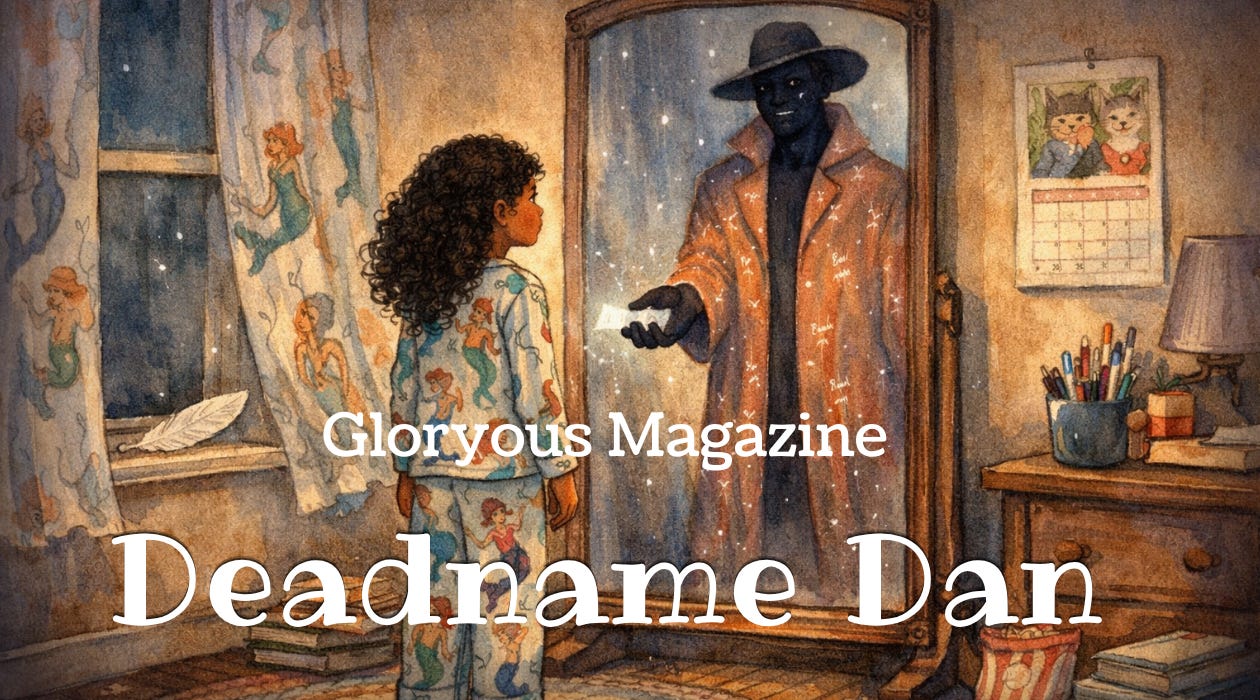
After her grandmother accidentally calls her by the wrong name, twelve-year-old Abigail finds herself clinging to a strange piece of playground folklore: whisper to Deadname Dan under the full moon, and he will carry away the name that was never truly yours.
What begins as a desperate hope turns into something stranger, older, and kinder than Abigail ever imagined. Because Deadname Dan is no thief. He is a keeper of outgrown names, carrying them from the children they wound to the children they were always meant to find.
Tender, magical, and full of heart, Deadname Dan is a middle-grade fable about identity, family, and the quiet ways the world can be mended.
If you’ve ever wished the world would stop catching on the wrong edge of you, this story is for you.
❤️ Tap the heart button
💬 Leave a comment—tell me what part resonated, or share your favorite gentle folklore, magical-being, or moonlit-story moment
☕ Toss a coin in the snack fund if you’d like to support more stories full of tenderness, folklore, and queer hope: → Ko-fi | Venmo | CashApp
Your support keeps Gloryous Magazine full of strange little miracles, soft-hearted folklore, and stories that believe healing is possible. 💛
📚 Stay tuned for more at Gloryous Magazine:
☕ Stay connected with the Coffee Bunny Crafter’s Café
Subscribe for cozy chaos, creative magic, and behind-the-scenes updates:

Find me, Glory Fink / @Glory Writes The Blues, on social media:
🌤️ BlueSky 📸 Instagram 📹 YouTube 🎮 Twitch
Deadname Dan
Some names are not lost. They are only on their way home.
By Glory Fink
After a tough day at school, Abigail lay on her stomach on the braided rug in her bedroom, chin in her hands, while her best friend Tamantha kicked her feet in the air beside her and said, “Did you see the new episode of Undersea Kingdom last night?”
Abigail groaned into the rug.
“The one where Prince Nerion gets turned into seafoam because he broke the Moon Tide Treaty?” Tamantha pressed. “Tell me you saw it.”
“I saw it,” Abigail said, rolling onto one elbow. “And first of all, if that man did not want to be turned into seafoam, he should have stopped acting like the mayor of Bad Decisions.”
Tamantha slapped the rug. “That is exactly what I said.”
“And second,” Abigail went on, warming to the subject in spite of herself, “Queen Seraphina absolutely knew the treaty was cursed from the beginning. She just kept letting everybody monologue instead of stabbing the problem.”
Tamantha sat up straighter. “See? This is why we should be on the writing team.”
The room around them cradled the soft clutter of an ordinary, beloved life. There were library books stacked crooked by the bed, a lavender lotion bottle on the dresser, and a pencil cup overflowing with gel pens. A plain full-length mirror hung on the closet door. The curtains were printed with mermaids and merboys, their tails a little faded from the sun. Beside the mirror on the wall hung a calendar with kittens dressed like librarians. Between them on the rug sat an old copy of Equestrian Life from the dentist’s office and a half-finished bag of peppermint sticks they had meant to save for later.
Abigail reached for another peppermint stick just as the door opened with a quiet bump.
Grandma came in carrying a plate of baloney-and-cheese sandwiches and two cold cans of grape Shasta, silvered with tiny beads of water.
“I brought some snacks for you and your friend, Oliv—ah, uh, Abigail,” Grandma said, her lips pursing with embarrassment at her fumble.
The correction arrived too late to keep from landing.
Abigail’s hand stopped halfway to the peppermint sticks.
For one awful second it felt as though the whole room had tipped a little sideways. Her cheeks went hot. She looked down too fast, fixed her eyes on the rug, and said, quick as a match strike, “It’s okay.”
Grandma’s face turned pink. “I’m sorry, sugar.”
“It’s okay,” Abigail said again.
But it was not okay, and both girls knew it.
Grandma set the plate and sodas on the desk and slipped back out, closing the door gently behind her, as if gentleness might mend what had already happened.
For a little while, neither girl spoke. One soda gave a tiny settling hiss and pop of pressure change.
Tamantha picked up a peppermint stick, unwrapped it, then didn’t eat it.
The room seemed to listen to its own silence.
Abigail gazed at the rug and worried a loose thread between her fingers.
Tamantha, who could usually talk through anything from math tests to lizards to why cafeteria pizza tasted “emotionally dishonest,” went very still.
At last she said, “I thought your family got used to your name in fifth grade, two years ago.”
“They did,” Abigail answered.
Tamantha raised her eyebrows.
Abigail sighed. “Mostly.”
The word sat between them like a pebble in a shoe.
After a moment Abigail said, “They love me. They really do. That’s what makes it hard. They aren’t trying to be mean. They just...” She searched for the shape of it. “Sometimes it feels like they remember the wrong thing first.”
Her eyes drifted toward the mirror and then away again.
“It’s like they’re calling to somebody who used to stand where I’m standing,” she said quietly. “Not a bad somebody. Not a wrong somebody, exactly. Just... not me.”
Tamantha’s face, always open as a front porch, went very still and serious.
“I wish,” Abigail said, her voice thinning to almost nothing, “I wish they could just forget I ever had another name.”
At that, Tamantha glanced toward the bedroom door.
Abigail noticed.
“What?” she asked.
Tamantha leaned closer. “My cousin told me something over spring break.”
“What sort of something?”
“The sort you only tell somebody if you mean it.”
Abigail narrowed her eyes. “Tamantha.”
Tamantha bent nearer still, cupped one hand to the side of her mouth, and whispered, “Deadname Dan.”
Abigail blinked. “Who’s Deadname Dan?”
Tamantha’s hand flew to her chest. “Shh! Don’t say it so loud.”
Abigail gave her a skeptical look. “Why not?”
“Because names have ears,” said Tamantha gravely. “And his especially.”
Abigail almost laughed.
Tamantha’s cousin was older and therefore, by middle-school law, understood several important mysteries of the universe, but this still sounded like exactly the kind of nonsense somebody’s cousin made up to scare people at sleepovers.
Still, Abigail did not laugh.
Tamantha lowered her voice even more.
“If you ask him in the right way during the full moon, he’ll come and take away a name that makes you sad whenever you hear it.”
Abigail sat up straighter before she could stop herself.
“What do you mean, take it away?”
“Not like crossing it out on paper,” Tamantha said. “Not like pretending it never happened. More like... carrying it off. Bit by bit, while the moon slowly disappears. After that, people stop reaching for it. They stop remembering it belongs to you.”
Hope flared in Abigail so suddenly it almost hurt.
“Gone?” she whispered.
“Gone from the mouths that keep using it wrong,” Tamantha said. “But not lost.”
Abigail frowned. “How can it be gone and not lost?”
Tamantha shrugged one shoulder. “My cousin says Deadname Dan never wastes a name. He carries it where it needs to go.”
Abigail picked at the edge of a peppermint wrapper. “That sounds fake.”
“It might be,” Tamantha admitted.
Abigail looked up, surprised.
Tamantha lifted one shoulder again. “I’m just saying, my cousin swears it’s true. And he knew about Ms. Terriberry eloping before anybody else did, so.”
“That does not prove ghost stuff.”
“I didn’t say he was a scientist,” said Tamantha. “I said he knows things.”
Abigail snorted in spite of herself.
Then her face sobered again.
“What if I don’t want anybody to have it?” she asked.
Tamantha considered this the way she considered whether a frog looked sick or merely offended.
Then she said, “Maybe that isn’t how names work.”
Abigail said nothing.
“My cousin said names aren’t bad,” Tamantha went on. “Just sometimes they get handed to the wrong person first. Deadname Dan takes them where they belong.”
The promise of her words settled over the room in a hush.
Abigail turned toward the mirror on the closet door. In its long glass she could see both of them, small and solemn, caught between childhood and whatever came next.
“Do you know how to call him?” she asked.
Tamantha nodded.
“Show me.”
They stood before the mirror together, Abigail in front and Tamantha just behind her, their reflections layered one over the other in the pale afternoon light.
“I’m not saying his whole name,” Tamantha whispered. “My cousin said that’s asking for too much attention. I’ll say ‘Mmmm’ instead. But you have to say his real name each time or it won’t work.”
Abigail nodded.
Her stomach fluttered in a way she did not care for.
Softly, both girls looking straight into the mirror, Tamantha began:
“Mmmm Dan, Mmmm Dan
come as quick as you can,
I’ve got a name for you to claim in your hand.”
Then she leaned in so close Abigail could feel the warmth of her breath.
“You have to say it again by yourself during the full moon,” she whispered. “And you have to mean it all the way down, ’cause he only hears those who really need him.”
Abigail looked at herself in the glass and felt, all at once, ridiculous and hopeful and a little bit sick.
Just then came a light tapping from the hallway.
“Knock, knock,” Grandma called. “Girls? Knock knock?”
The door opened a crack.
“Tamantha, your mama called. She’s outside with frozens, so you’d better hurry, dear.”
Tamantha turned to the kitten calendar hanging by the mirror and checked the date.
Then she leaned close to Abigail one last time and murmured, “The full moon is in three days.”
For the next three days, it was all Abigail could think about and little else.
She thought about it while brushing her teeth, and while trying to divide fractions, and while folding bath towels warm from the dryer. She thought about how amazing it would be if it really was that simple. She thought about it in the line at the grocery store and in the school hallway—how much easier home would feel if she never had to wonder whether Grandma was going to forget again.
And then she would feel foolish.
Because what kind of twelve-year-old stood in front of a mirror and called for a moon-spirit named Deadname Dan?
The kind in stories, maybe.
The kind in stories who ended up cursed if they weren’t careful.
That thought lodged under her ribs and stayed there.
What if Tamantha’s cousin was making the whole thing up, and Abigail did it anyway and had to stand there afterward in her mermaid pajamas feeling like the loneliest fool in Mississippi?
What if it was real?
That seemed, somehow, both better and worse.
Because if it was real, then something might answer.
And if something answered, how could Abigail know whether it would be gentle?
She pictured all kinds of dreadful possibilities in the dark while she was supposed to be falling asleep: a face in the mirror with no eyes, a laughing thing with too many teeth, some ancient mischief that would hex her for asking to be rid of a name it thought she ought to keep.
Then she would scold herself for being dramatic.
Then she would remember Grandma’s face going pink with shame and hear that wrong name strike the air again like a dish breaking in another room.
She thought about it each time somebody used the wrong name and apologized right after, tender and flustered and ashamed. She thought maybe she would really be doing everyone else a favor if they no longer had to worry about her old name, either.
And then that thought made her feel guilty.
Because wasn’t that selfish? Wasn’t it childish to want the world rearranged around your hurt? Wasn’t it ungrateful to want more care from people who already loved you?
But every time she tried to reason herself out of it, hope rose right back up through the cracks.
Cruelty could be fought.
Cruelty was simple.
But love, when it blundered, left a bruise shaped like confusion.
Abigail did not want anyone punished. She did not want anyone to suffer. She only wanted the world to stop catching on the wrong edge of her.
By Thursday evening, hope had outlasted embarrassment.
Not by much.
But enough.
Thursday came soft and silvery.
After dinner, Abigail took a warm shower and moved slowly through the ordinary bedtime rituals that steadied her. She rubbed oil into her curls. She combed them carefully. She wrapped them for a little while in a soft T-shirt to dry. She moisturized her face and arms. Then she put on her favorite pajamas, the ones with mermaids and merboys printed all over the pants, and sat on the edge of her bed to twist her hair into neat two-strand ropes.
That was when she noticed how bright the moonlight was.
It slipped through the curtains in long pale ribbons, so luminous it looked almost liquid.
Abigail’s hands went still.
The house had settled into its nighttime self: the refrigerator humming low in the kitchen, the old boards whispering as they cooled, the far-off bark of a dog, then quiet again.
She stood.
Barefoot, she crossed the room to the mirror.
There she was: twelve years old, in mermaid pajamas, curls half-twisted, frightened but brave and tired of flinching at a name that had once been hers only because no one had known any better.
The moon laid a silver hand across her reflection.
Abigail swallowed.
This is silly, she thought.
If nothing happens, I am going to feel so stupid.
Her hand tightened around one half-finished twist of hair.
And if something does happen?
That thought nearly sent her back to bed.
She stood very still, listening to the hum of the refrigerator, the breathing hush of the house, the ordinary sounds of a world in which mirrors were just mirrors and girls were supposed to know better than to invite moonlit strangers into their bedrooms.
Then, as if memory had been waiting for exactly that moment, she heard again Grandma’s quick, embarrassed correction.
Oliv—
The old hurt moved through her like a cold draft.
Abigail lifted her chin.
“I can’t keep doing this,” she whispered to the girl in the glass.
Then she spoke:
“Mmmm Dan, Mmmm Dan
come as quick as you can,
I’ve got a name for you to claim in your hand.”
Her voice shook.
She almost stopped there.
Instead she drew in a breath and began again, more steadily this time:
“Deadname Dan, Deadname Dan,
come as quick as you can.
I’ve got a name for you to claim
in your hand.
Deadname Dan, Deadname Dan,
come as gentle as you can.
Here’s a name that isn’t mine.
Help it go where it will shine.
Deadname Dan, Deadname Dan,
if you hear me, if you can,
take this name I’ve outgrown through
to someone it belongs to.”
At first, nothing happened.
The mirror stayed a mirror. The room stayed a room.
Abigail felt a little foolish all at once, which was a miserable feeling. Heat crawled up her neck. She had just about decided she was never, ever telling Tamantha whether she’d done it when the air changed.
Not colder, exactly.
More like the whole room had drawn a breath and was waiting to see what would happen next.
Moonlight rippled across the glass.
A figure began to gather in the mirror as if it were stepping out from a country made of frost, paper, and old songs.
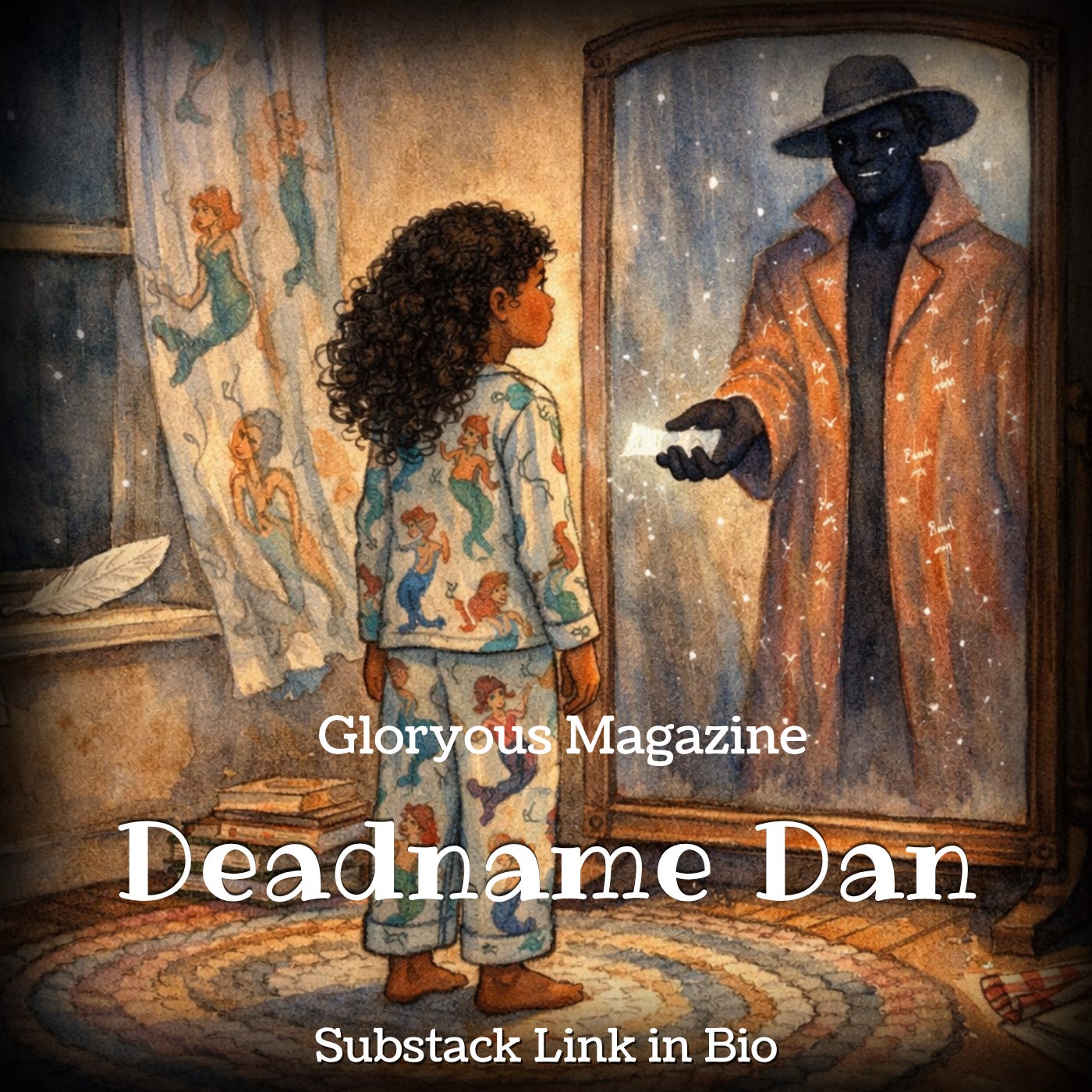
He was tall and narrow as a birch tree, dressed in a long coat the color of dawn before the sun arrives. Moonlight clung to the seams. His hair was white as thistledown, and his eyes were bright and patient and full of distances. He wore a hat with a brim soft as felt, and around him moved the faintest sound, like pages turning in a library after everyone had gone home.
He touched two fingers to the brim of his hat.
“Good evening, Abigail,” he said.
His voice sounded like an old story remembering itself.
Abigail’s heart gave one frightened leap.
She took half a step back before she could stop herself.
“You’re real,” she whispered.
“So are you,” he answered.
There was a hint of humor in his voice, quiet and dry as autumn leaves.
“Are you Deadname Dan?” she asked.
“I am,” he said. “Though most children prefer whispering.”
Abigail ducked her head. “Sorry.”
“No harm done,” he said kindly. “Sincere children are rarely quiet.”
That almost made her smile.
Almost.
She clasped her hands to keep from fidgeting. “If I give it to you... will it hurt?”
Deadname Dan’s face gentled.
“No,” he said. “Not in the way you mean.”
She searched his moon-bright face.
“My family won’t forget me too?”
“No,” he said. “Your name is Abigail. What is truly yours, I do not touch.”
That let out some small, tight breath inside her she had not realized she was holding.
“Can you really do it?” she asked.
“Sometimes,” said Deadname Dan.
He stepped nearer within the mirror, and Abigail saw that tiny silver letters glimmered in the seams of his coat—some printed, some looped, some careful, some wild—as if names had come to rest there from every corner of the world.
“I only take names that have truly been outgrown,” he said, “and only when they are given freely.”
“My old name isn’t bad,” Abigail said at once.
“No,” said Deadname Dan. “Most names are not.”
“It just doesn’t fit me.” Her voice shook, but she kept going. “It feels like a sweater I outgrew years ago that everybody keeps trying to pull over my head. I can’t breathe right in it.”
Deadname Dan nodded as if this were a familiar sorrow.
“And my family loves me,” Abigail hurried on. “They’re trying. They really are. I don’t want them hurt.”
“They will not be hurt,” he said. “I am not in the hurting business.”
He folded his hands behind his back.
“My work is not to destroy names,” he said. “My work is to carry them. Some names arrive too early. Some too late. Some are handed to the wrong child altogether. I take them from the places where they pinch and chafe and echo wrongly, and I bear them onward until they reach the soul they were meant to find.”
Abigail looked up into his moon-bright face.
“So it won’t just vanish?”
“No name worth speaking truly vanishes,” he said softly. “That would be wasteful, and the world is already full of too much waste.”
He lifted one hand, and in the silver of the glass Abigail glimpsed brief, flickering scenes: a swaddled baby blinking under hospital lights; a child on a bus with their backpack hugged close; a boy in a school hallway practicing possible names silently behind his teeth; a little one standing in a field, muddy-kneed and laughing, waiting for a call that would sound right when it reached him.
“Somewhere,” Deadname Dan said, “there is always someone waiting for a name that will fit like birdsong in the chest.”
Something loosened in Abigail then, a knot she had been carrying for so long she had nearly mistaken it for part of herself.
“Will I forget?” she asked.
“No,” he said. “Your history remains your own. I do not take memory from the one who has lived it. I only ease the hands of those who keep reaching, by habit, for what no longer belongs to you. As the moon wanes, the path to that old name will grow over. Gently. Like a footpath through summer grass.”
That seemed fair. More than fair.
It seemed kind.
Deadname Dan held out his hand through the surface of the mirror.
Abigail tensed for one startled second when his hand passed through the glass like moonlight through water.
Resting on his palm was a slip of paper white as moth wings. Written on it in neat schoolroom letters was her old name.
Abigail stared at it.
For one moment sadness rose in her—not because she wanted the name back, but because she had carried it for so many years. Even an ill-fitting thing could leave its shape behind when taken off.
Deadname Dan waited without hurrying her.
At last Abigail reached out and touched the paper. It was cool and smooth and light as onion skin.
“I give it freely,” she said.
The instant the words left her mouth, the letters lifted from the page in a silver shimmer and spiraled upward like seeds caught on a night wind. They threaded themselves into the seams of Deadname Dan’s coat, where they rested among the others.
He bowed his head.
“By the darkening moon,” he said, “this work will be done.”
Abigail, because politeness still mattered even in the presence of moonlit folklore, whispered, “Thank you.”
His smile was small but deep.
“You are most welcome, Abigail.”
The mirror rippled once.
Then it was only glass again, reflecting a girl in mermaid pajamas, moonlight across the floorboards, and a room that seemed somehow wider than it had before.
On the windowsill lay a single white feather no larger than a leaf.
Abigail picked it up and tucked it into her diary.
The moon began to shrink.
And little by little, so did the mistakes.
At breakfast the next morning, her uncle reached for the syrup and said, without hesitation, “Abigail, could you pass that to me?”
Grandma called from the porch that afternoon, “Abigail, your friend Tamantha’s on the phone!”
A cousin writing a birthday card paused, frowned at the envelope, and then laughed softly to herself. “Now what on earth was I fixing to write?”
No one seemed frightened. No one seemed confused for long. It was only as though an old, wrong road in their minds had slowly grown over with moss and grass, until at last their feet found the right one without effort.
By the time the moon had thinned to a silver clipping in the sky, the old name no longer came crashing into Abigail in the ordinary hallways of her life.
The house felt gentler.
So did the space inside her own ribs.
She still remembered, of course.
But the remembering no longer felt like being tugged backward by the sleeve.
It felt like a page already turned.
Several weeks later, on a Saturday morning bright with spring, Abigail went with Grandma to the farmers market downtown. Grandma wanted tomatoes, local honey, and a chance to exchange three different pieces of church news disguised as concern.
The market was full of voices and baskets and the smell of peaches warming in the sun. Children darted between the tables. A fiddler played something lively near the bread stand. Bees moved lazily among buckets of zinnias.
At the far end of the market, beside a table stacked with homemade soap and jars of fig preserves, stood a little boy of about six. He wore new sneakers, one sock sagging into his shoe, and the serious expression of a child trying to decide between two cookies the size of saucers.
Beside him stood a man in pharmacy scrubs, smiling down with patient fondness.
The soap-maker laughed and asked, “And what’s your name, sugar?”
The boy drew himself up proudly.
“Oliver,” he said.
The name rang clear and easy in the bright air.
Abigail stopped walking.
For one tiny instant, she simply stood there with all the market moving around her.
And then she felt it.
Not pain.
Not even sadness.
Just a quiet, shining sense of rightness, like hearing the last note of a song resolve exactly where it should.
Oliver.
Here.
On him.
Not wrong. Not broken. Not haunting.
Simply home.
The boy beamed when he was handed the bigger cookie. The man beside him touched the top of his head with such automatic tenderness that Abigail thought at once of moonlight, silver seams, and a coat full of traveling names.
Grandma turned around with a bag of tomatoes in her hand.
“Abigail,” she called, “come look at these peaches.”
Abigail glanced once more at the little boy named Oliver.
Then she smiled—a real smile, easy and whole.
“I’m coming,” she said.
That night she opened her diary and took out the white feather.
Below it she wrote, in her neatest handwriting:
Some names are not lost.
Some names are only on their way.
She sat for a long while with the diary open in her lap, thinking of roads under moonlight, of children becoming themselves, of all the quiet work done in the world that no one ever saw.
Somewhere, she thought, Deadname Dan was walking beneath the thinning moon in his pale dawn-colored coat, carrying names with care from the children who had outgrown them to the children who were waiting.
Not stealing.
Not erasing.
Only mending a small imbalance here and there.
Only helping the world fit a little better.
Abigail touched the feather once, then closed the diary and set it on her nightstand.
When she climbed into bed and pulled the covers up under her chin, she felt, from the roots of her hair to the soles of her feet, exactly like herself.
And outside her window, the moon kept watch over all the names still traveling home.
Acknowledgements
Special thanks to Grayson Wilde Grayson Wilde , whose original mention of the name Deadname Dan on his website tickled my imagination. Years ago, he also gave me permission to play with the idea of making Deadname Dan into some kind of character, and the idea delighted me so thoroughly that I couldn’t let it go.
Thank you to Charlie Dorsett (they/she) for helping edit this story with such care.
Thank you to my brother Tom Fin for helping me spin a piece of folklore I couldn’t forget into something fuller, stranger, and more whole.
Thank you to River for reading through this story and helping me get the tone and sentiments just right.
And thank you to everyone who encouraged me over the several years this story grew from a passing idea into a fully fledged piece of lore. Every single person I pitched this idea to insisted I keep working on it, because they fell in love with Deadname Dan and Abigail as much as I did. That kind of encouragement matters more than I can say.
I’m publishing this just after International Transgender Visibility Day, and I want this story to be a small gift to all the young—and young-at-heart—people brave enough to forge their own paths, even when they don’t yet know exactly where they’re headed or what will meet them on the other side.
I walked that path once upon a time. Truth be told, I’m still walking it. I’m still figuring myself out even as an adult. And I am cheering for each and every one of you.
It takes courage to walk this road. It is not always easy, and it is not for the faint of heart. But it does get better. I promise.
One day, you are going to look in the mirror and truly, wholeheartedly love the person looking back at you.
Just you wait and see.
— Glory Fink
Bonus! This meeting went long ;D